

Wood and Composite Decks in New Jersey: Which Material Is Right for Your Home?
Choosing between a wood deck and a composite deck is one of the most important decisions you will make in any outdoor project. The material determines how your deck looks, how much upkeep it needs, how long it lasts and how much you spend, both now and over the years. At Joe’s Construction & Remodeling, LLC, we install both wood decks and composite decks for homeowners across Morris County and Northern NJ, and we will give you an honest recommendation based on your home, your budget and your lifestyle.
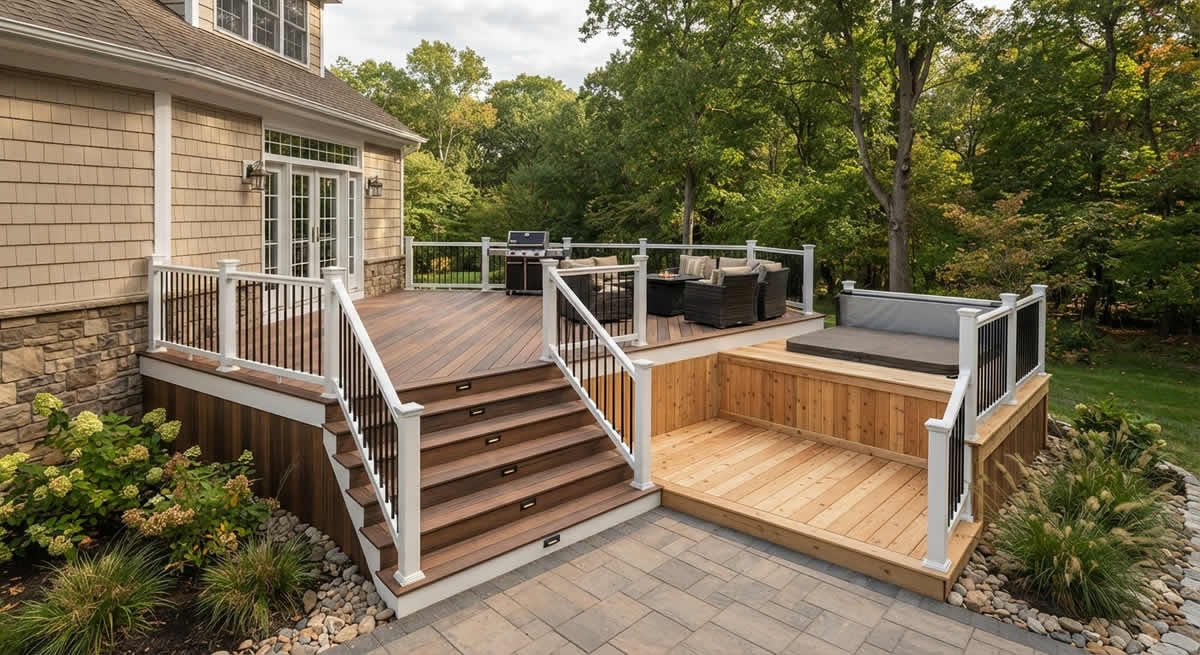
Composite decking with clean railings installed by our team in Morris County, NJ.
This guide compares the two materials side by side, with a focus on what matters in New Jersey’s climate of freezing winters, humid summers and heavy seasonal moisture.
Wood Decking: Natural Beauty and Lower Upfront Cost
Wood is the traditional choice for decks, and for good reason. It has a warm, natural look that many homeowners prefer, and it is generally less expensive to purchase and install than composite. Common wood options include:
- Pressure-treated lumber: the most budget-friendly option, treated to resist rot and insects. It is widely used for both framing and decking surfaces.
- Cedar: a naturally attractive softwood with good resistance to decay and a richer color than pressure-treated lumber.
- Hardwoods: dense, long-lasting woods that offer a premium appearance and strong durability, typically at a higher price.
Advantages of Wood Decks
- Authentic look and feel that blends well with traditional and rustic homes.
- Lower initial investment, which leaves more budget for size, stairs or design features.
- Easy to repair, since individual boards can be replaced.
- Can be stained or painted in different colors over the years.
Drawbacks of Wood Decks
- Requires regular maintenance, including cleaning and periodic sealing or staining.
- Can warp, crack, splinter or fade with sun and moisture exposure.
- May be susceptible to rot and insects if not maintained properly.
Composite Decking: Low Maintenance and Long-Term Performance
Composite decking is made from a blend of wood fibers and plastic, designed to look like wood while resisting many of its weaknesses. It has become a popular option among homeowners who want to spend more time enjoying the deck and less time maintaining it.
Advantages of Composite Decks
- Low maintenance: no sealing or staining. Occasional cleaning with soap and water is usually enough.
- Resistant to rot and insects: composite does not decay like untreated wood.
- Fade and stain resistance: many modern products are designed to hold color and withstand everyday spills.
- Splinter-free surface: comfortable for bare feet, children and pets.
- Wide range of colors and textures, including realistic wood grain patterns.
Drawbacks of Composite Decks
- Higher upfront cost than pressure-treated lumber.
- Some products can get warm in direct summer sun, particularly darker colors.
- Quality varies between manufacturers and product lines, so selection matters.
- Installation must follow manufacturer requirements for spacing, fastening and ventilation.
Wood vs. Composite: Direct Comparison
- Upfront cost: wood is generally lower. Composite is generally higher.
- Maintenance: wood needs regular sealing or staining. Composite needs basic cleaning.
- Lifespan: well-maintained wood can last many years, while composite is designed for long-term durability with less upkeep. Actual lifespan depends on product quality, installation and care.
- Appearance: wood offers authentic natural character. Composite offers consistent color and a variety of finishes.
- Repairs: wood boards are easy to replace individually. Composite boards can also be replaced, but color matching can be harder over time.
- Long-term value: composite can cost less over the long run when you factor in reduced maintenance, though wood is still an excellent value for many projects.
How New Jersey Weather Affects Your Decking Choice
Outdoor structures in Northern New Jersey go through a lot: snow loads, freeze-thaw cycles, summer humidity, rainstorms and strong sun. These conditions affect each material differently.
- Moisture and humidity: wood absorbs and releases moisture, which can lead to cupping, cracking and rot without proper maintenance. Composite handles moisture better, although proper ventilation and drainage are still important.
- Freeze-thaw cycles: expansion and contraction can loosen fasteners and stress boards. Correct spacing and quality hardware protect both materials.
- Snow and ice: shoveling and de-icing products can scratch or damage some surfaces. We advise on products and methods that suit your decking.
- Sun exposure: UV can fade and dry out wood, and darker composite boards may heat up. Light colors and shade solutions help.
Whichever you choose, the framing and footings beneath the surface matter just as much. A deck is only as strong as its structure, which is why proper footings, framing, flashing and attachment to the home are core parts of our deck building services.
Which Material Is Right for You?
Wood May Be the Better Fit If You:
- Want the lowest upfront cost or a larger deck within a set budget.
- Love the natural look and do not mind periodic maintenance.
- Own a traditional or historic home where natural materials suit the architecture.
Composite May Be the Better Fit If You:
- Want to minimize time spent on upkeep.
- Plan to stay in the home long term and value durability.
- Have children or pets and prefer a splinter-free surface.
Some homeowners combine both: pressure-treated framing for structure with composite surface boards and railings for low-maintenance beauty. We will discuss mixed options during your consultation.
Professional Installation Makes the Difference
Even premium materials fail when they are installed poorly. Correct installation includes proper board spacing for drainage and expansion, the right fasteners, adequate ventilation beneath the deck, secure railings and stairs, and a safe connection to the house. Many composite manufacturers require specific installation methods to preserve product performance, so careful work matters.
Deck projects in New Jersey typically require permits and inspections through your local construction office. We help you understand what your town requires, and we encourage you to confirm that any contractor you hire is registered with the state and fully insured. We are insured and happy to answer questions about the process.
Our Process for Wood and Composite Deck Projects
- Free on-site consultation: we assess your space and discuss budget, style and maintenance preferences.
- Material comparison: we show you options and explain the pros and cons of each.
- Transparent estimate: clear pricing before any work begins.
- Expert installation: footings, framing, decking, railings and details completed with precision.
- Walkthrough and care guidance: we explain how to clean and maintain your deck for the best results.
Decks Across Morris County and Northern NJ
We install wood and composite decks in communities including Boonton, Chatham, Denville, East Hanover, Hanover, Harding, Jefferson, Long Hill, Mendham, Montville, Parsippany-Troy Hills, Pequannock, Randolph, Rockaway and Roxbury. See our full service area or learn more about Morris County, Bergen County and Sussex County.
Planning steps from your deck down to the yard? Our porch and steps and masonry and paving services can complete the outdoor space.
Frequently Asked Questions
Is composite decking worth the extra cost?
For many homeowners, yes, especially those who value low maintenance and plan to stay in their homes for years. If your budget is tight or you enjoy the look of real wood, a well-maintained wood deck is still a great choice.
How often does a wood deck need to be sealed or stained?
It depends on the wood, exposure and product used, but wood decks generally need regular attention. We can recommend a maintenance routine for your specific deck.
Can I replace only the surface boards of an existing deck?
If the framing and footings are in good condition, yes. We inspect the structure first to make sure it can support new decking safely.
Do you install both materials?
Yes. We install wood and composite decks and help you choose the best fit.
Get Your Free Wood or Composite Deck Estimate
Not sure which material fits your home? Talk to our team. Call 973-876-7130 or 973-580-5598 to schedule your complimentary on-site consultation, or request your free quote online. We are fully insured, transparent about pricing and fluent in English and Spanish. ¡Hablamos español! Browse all of our services to plan your next project.